
Home / Services / Chemical treatment
Chemical treatment
Algae and weeds can take over a lake fast in the Arizona heat. We treat them with EPA-registered aquatic herbicides and algaecides, applied by licensed technicians under Jeff Jenkins, an Arizona Qualified Party in Category 5 Aquatics with more than 30 years in the field.
Careful work matters as much as the product. We identify the problem before we choose a treatment. We check your water before using copper. We treat large growths in sections so fish keep the oxygen they need. And we follow every label, because the label is the law.
Golden algae (Prymnesium parvum) has killed fish in Arizona lakes, including Saguaro, Canyon and Apache. It gives off a toxin that damages fish gills, so fish suffocate even while the water still holds oxygen. It turns most toxic when the water runs short of nitrogen and phosphorus. There is no proven cure: algaecides cut the number of cells but not the toxin. We test for it, and where it is present we use periphyton habitats to keep the lake's nutrients and food chain in balance — an approach that is showing promise on the lakes we look after.
Request a free site assessment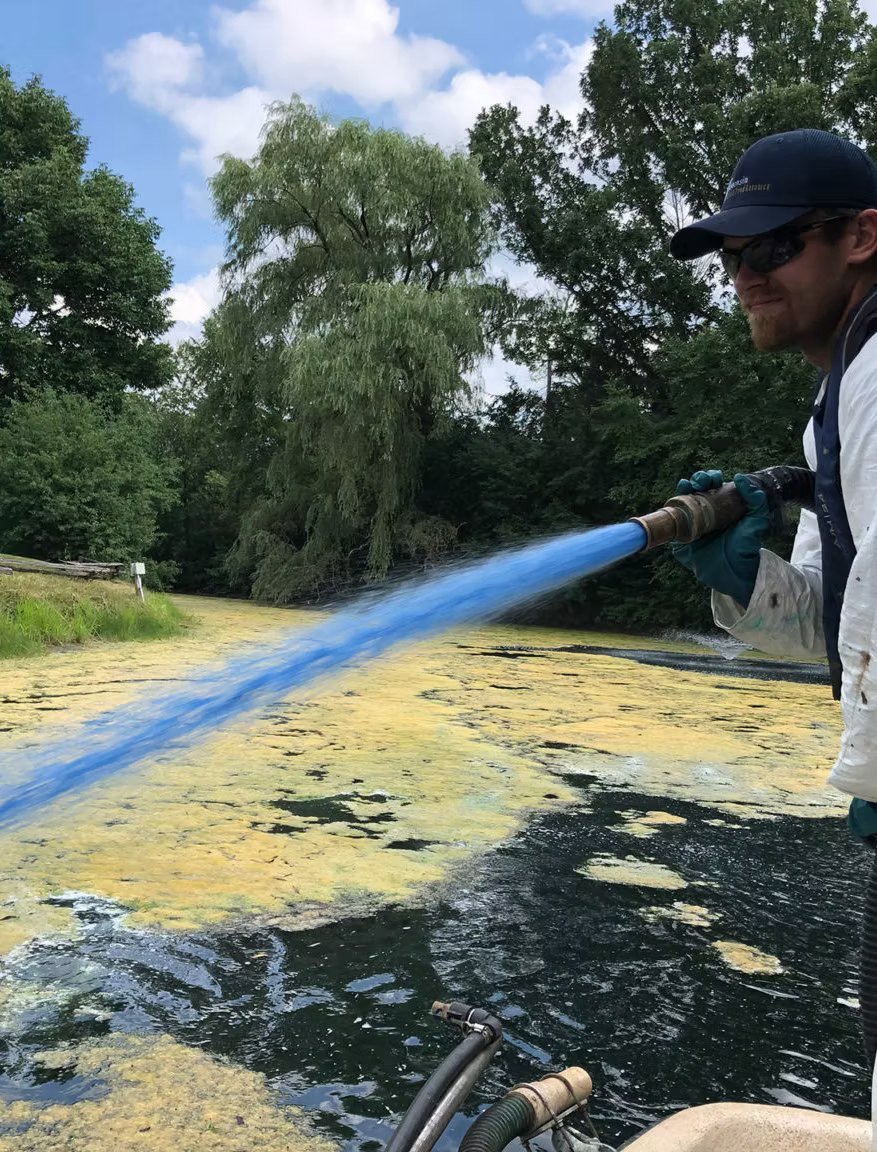
What we treat
- Filamentous algae (string algae and floating mats)
- Planktonic algae blooms (green water)
- Submerged weeds
- Invasive and nuisance aquatic plants
- Golden algae (Prymnesium parvum)
How it works
- Identify firstWe find out exactly what is growing, because filamentous algae, planktonic algae and submerged weeds each need a different product.
- Test and planWe test your water, including alkalinity before any copper treatment, and check label rules on swimming, irrigation and other water use.
- Treat in sectionsOn heavy growth we treat part of the water at a time, so decaying plants do not use up the oxygen your fish need.
- You get the recordBefore and after photos, readings and products used, by email and in your client portal.
The science behind it
Algae and weeds are living plants, and how they die matters. When a large mass dies at once, the bacteria breaking it down use up the water's oxygen and fish can suffocate. That is why extension services advise treating a quarter to a third of a pond at a time.
The product matters as much as the dose. In research by our supplier SePRO, a chelated copper controlled tough nuisance algae that plain copper sulfate did not, and a peroxide algaecide cut a blue-green bloom within a day and broke down to nothing by the next. Their multi-year reservoir program shrank the area needing treatment by 51 to 95 percent: steady management beats one big hit.
Chemicals control the growth, not its cause. Lasting control also means reducing the nutrients feeding it. Golden algae is different again: no algaecide yet removes its toxin.
This is why we hold the Arizona Lake Symposium every year, with PMD CEU training credits. We use the science and apply it to what we see and measure on your water. No canned plans from a desk at a distant head office.
About the symposium →Want to dig deeper? These are the studies and guides behind this page:
- Oklahoma State — Aquatic weed management: herbicides
- Texas A&M AgriLife — Treating in sections to protect dissolved oxygen
- Texas A&M AgriLife — Filamentous algae and copper
- Oklahoma State — Copper sulfate and alkalinity
- Texas A&M AgriLife — Managing and controlling algae in ponds
- New Mexico State University — Algae control and nutrients
- New Mexico State University — Golden algae
- EPA — The pesticide label is the law
- Water, Air & Soil Pollution (SePRO co-authored) — Copper formulation and tough algae
- Water (SePRO co-authored) — Peroxide algaecide on a blue-green bloom
- Applied Water Science (SePRO co-authored) — A long-term algae program on three reservoirs
Other services: Water analysis · Biological augmentation · Fish stocking · Periphyton habitats